Used Ns 10 Yamaha Sale
By Phil WardLove or hate the Yamaha NS10, this unassuming little speaker has found a place in the studios of many of the world's top producers. We trace its history, and investigate why a monitor whose sound has been described as 'horrible' became an industry standard.What is it about the Yamaha NS10?
If any piece of pro audio hardware deserves that over-used term 'industry standard' it has to be the NS10. In a professional audio world continually seduced by the next big thing, where plug-ins can provide a near instantaneous GAS (Gear Acquisition Syndrome) fix, where products live or die thanks to their quantity of bells and whistles, and where the number of contemporary nearfield monitors that could apparently do the job of an NS10 is almost beyond count.
Yamaha NS-10M Studio Monitor SUPER CLEAN. Sits sideways which is the original way these were made. The ones sitting up were made later. Condition is Used but in almost new condition. Find great deals on eBay for yamaha ns 10 and yamaha ns10m. Shop with confidence. 64 results for yamaha ns 10. EBay determines this price through a machine-learned model of the product's sale prices within the last 90 days. Top Rated Plus. Sellers with highest buyer ratings; Returns, money back. Motorcycles on Autotrader has listings for new and used Yamaha YZF-R1 Motorcycles for sale near you. See prices, photos and find dealers near you.
The venerable, tired old Yamaha is the one piece of kit that still appears in almost every photograph of a smiling engineer posed at his desk.You don't have to hang around long in the SOS Forum for a thread to appear that features the Yamaha NS10. Even in threads that begin with some other monitor subject, the NS10 seems to possess a gravitational influence that inexorably results in discussion of its merits, or otherwise.
Few subjects excite so much passionate opinion and, as is the way with passionate opinions, you don't find many in the middle ground: nobody says they 'quite like' or 'slightly dislike' the NS10; it's a definite case of love or hate, as evidenced by the SOS Forum quotes I've included in the 'Love 'Em Or Hate 'Em?' Within that context of polarised opinion, the NS10 generates a phenomenon that at first glance seems a little odd. You find those that, in professional terms can't live without it but often don't particularly enjoy listening to it, and, similarly, those that refuse to give it studio room but are often happy to admit that professionally it does a job.So what's going on? Not only should the NS10 by rights be nothing but a small footnote in the history of recorded music, but also there is precious little consensus or understanding about why we respond to it in the way we do, and why it's still found in almost every studio.
That's where this feature comes in — so if you've ever wondered why you're still using NS10s, even though you don't particularly enjoy the way they sound, and if you're prepared to forget some of what you thought you knew about monitors, read on.Part of the NS10's problem is that the general understanding of how we respond to monitors is coloured by their apparent technical simplicity and by manufacturers, sometimes innocently and sometimes intentionally, encouraging this phenomenon. In reality, the psychoacoustics of the perception of music reproduced by loudspeakers, and how this relates to their technical performance and specification, is an immensely complex subject that doesn't take kindly to simplification by marketing departments. By the time it lands on a sales brochure, a frequency-response curve, for example, is typically meaningless in terms of providing any information that's useful to an end user — even if it was measured competently and had any technical value in the first place. But then, in some respects, it can suit a manufacturer of monitors if their customers don't know too much.Misunderstanding also tends to breed misinformation, which is often disseminated by well-meaning amateurs: those whose knowledge of a subject is sketchy are always prey to the intuitively plausible but utterly wrong explanation for one phenomenon or another.
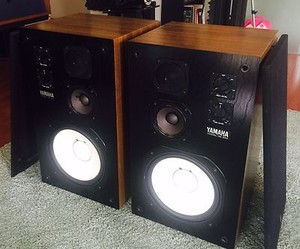
The hi-fi sector is well known for enthusiastically buying into the plausible (and often the implausible) as opposed to the factually correct. But we serious audio practitioners shouldn't start feeling smug, because the pro sector is not by any means squeaky clean on that front, especially where monitors are concerned. Occam's Razor, the principle beloved of physicists, which says that the most likely correct explanation for any phenomenon is probably the simplest one, never seems to have reached the audio business! During the NS10's 23-year life Yamaha manufactured a number of different versions (or perhaps just used a number of different logos):The NS10 started life as a (not very successful) hi-fi speaker: and the original NS10M shipped with cloth grilles, hence the grille-mounting sockets you find in the corners of this model (absent from the NS10M Studio that followed).
NS10M: The original domestic hi-fi speaker designed for vertical orientation (its front panel logo reads correctly with the speaker mounted with tweeter above woofer). This is the speaker that was too bright for Bob Clearmountain, leading him to resort to tissue paper over the tweeters — although, of course, it had to be the right kind of tissue paper.NS10M Studio: Some time after Yamaha got wind of the NS10M's popularity as a nearfield monitor (and around nine years after the original product launch) a version badged 'NS10M Studio' was produced. This version was designed for horizontal orientation (the logo and connection panel text were turned through 90 degrees), incorporated a redesigned tweeter and crossover to address the HF tonal balance issues, featured a more rugged cabinet design without grille-mounting sockets, and had improved connection terminals.Others: Web searches on NS-10 or NS10 will reveal some variants. There are versions badged NS10M Pro, NS10MX, NS10MC, NS10MT, and a miniature version that was sold in a 5.1 home-theatre package called the NS10MM. I've been unable to establish whether the NS10M Pro and NS10MX offer anything different (my guess is that they don't, but if anybody out there knows anything about them I'd love to hear it), but the NS10MC appears to be an NS10M Studio with a front grille, and the NS10MT appears to be a magnetically shielded and vertically oriented NS10M Studio with symmetrically arranged drivers and, wait for it. A reflex port.
Aaaargh!There are also obviously NS10-inspired products out there, by which I mean nearfield monitors with black cabinets and white cones. In the absence of any independent technical appraisal I'd be very wary of purchasing one on the assumption that it will offer anything like the performance of the genuine article. If you really want a pair of NS10s, eBay is probably your only real option, and you should expect to pay anything up to £350 for a pair in good condition.Before we get into the electro-mechanical and psychoacoustic nitty gritty that I know you're gagging for, let me take you through a little NS10 history. The Yamaha NS10 was designed by Akira Nakamura and launched in 1978, and it was as technically unremarkable then as it is now.
At that time Yamaha were also producing the more extraordinary NS1000 (also designed by Nakamura). With its beryllium mid-range and tweeter domes this speaker is technically advanced even now, and if you ever come across a pair in good condition, worth selling your own mother for. The NS10 began life as a domestic hi-fi speaker, but it was relatively poorly received and quickly faded towards obscurity.
How the NS10 was rescued from hi-fi death and resurrected as a nearfield monitor, single-handedly inventing a product sector as it did so, is a story that has probably been told slightly differently almost as many times as it's been told, but the version I'll tell here is, I believe, as close to the truth as makes no difference.To understand the history you first have to appreciate its context. The late '70s, when NS10s began to appear perched on meter bridges worldwide, was a transitional time in music recording. The divide between the engineer and the artist was blurring, as if the glass between the control room and the studio was melting. Desks were getting bigger as track count increased on tape.
Bob Clearmountain's other significant claim to fame is probably that he was the first to use tissue paper over NS10 tweeters in an attempt to dull their over-bright balance. He resorted to tissue paper after the maintenance staff at The Power Station had refused to modify the speakers by wiring resistors in series with the tweeters (why he didn't simply put an HF shelf EQ in the monitor chain is a question for which I don't have an answer).
Yamaha's second-generation NS10, the NS10M Studio, had a less bright balance, so removing the need for tissue paper. There's a technical analysis by Bob Hodas examining the effect of covering the NS10 tweeter with various types of tissue paper here:Jopson believes he was one of the first engineers regularly to use NS10s in the UK. His first pair was given to him by a producer just back from mixing a project at The Power Station in New York, after hearing that Rhett Davies and Bob Clearmountain had used a pair there while mixing Roxy Music's Avalon. However, Jopson goes on to say that Clearmountain himself recalls that NS10s were recommended to him by Bill Scheniman — who was the first engineer to bring a pair to New York, having used them at either Motown or Sunset Studios in LA. Bill Scheniman recollects that the pair of NS10s at Sunset (or was it Motown?) belonged to Grag Ladanyi, but that he had been convinced of their worth earlier, while working in Tokyo. Scheniman remembers using NS10s at two studios there: TakeOne, and another studio long-since forgotten. So, the most likely seed of the NS10's world domination was probably an unknown engineer at TakeOne studios in Tokyo — and not Bob Clearmountain looking for the worst speaker he could find!The rest, as they say, is history.
Yamaha Ns 10 Sk
Clearmountain in particular was (as he is now) a first-call producer and engineer for the biggest projects, and once he and a few others began to rely on the NS10, the phenomenon grew like a virus inhabiting a welcoming host: studios began to buy NS10s in their thousands in an effort to attract name engineers. Of course, in order to thrive, a virus needs a host to which it is particularly well suited, and this was provided by the rapidly increasing number of freelance engineers I described earlier.But in what respect was the NS10 so well suited to the nearfield monitor role? What was it that the unknown Tokyo engineer, Scheniman, Clearmountain, Davies, Jopson et al, heard to convince them that the NS10 was worth overturning their previous monitoring practices (predominantly Aurotones on the desk for AM radio/TV mixes, and big horn-loaded main monitors in the wall in front of the desk) for? Measurement of the low-frequency parameters of the NS10 bass/mid driver revels that it has a very high mechanical Q.
This means there's no eddy-current damping from the voice-coil former, which in turn means that it's almost certainly made from non-conductive Kapton (polyimide film) rather than the more usual, and conductive, aluminium. A Kapton fomer, while able to withstand pretty high temperatures, dissipates heat very poorly.I suspect that the success came from the NS10's only really unusual feature: its iconic white bass/mid driver cone. The cone wasn't just unusual because it was white, of course, but thanks to the way it was manufactured.
The vast majority of paper-based speaker cones are pressed from pulp using a mould — partly because moulding gives the designer the ability to specify a curved cone-profile, to enable a degree of tuning of the driver's frequency response and resonant behaviour. A cone with a curved profile will generally become less rigid towards its outer edge, so as frequency increases its effective radiating area and output level reduces. Designers often use this technique to delay the onset of directionality in bass/mid drivers, so allowing a higher crossover frequency than would otherwise be possibleThe curl-and-join construction of the NS10's paper cone (look closely and you can see the glued seam) is not typical of most speaker designs — and is a factor in the NS10's success in the studio.The NS10's bass/mid cone was not pressed but 'curled-up' from flat paper sheet and then glued (look closely at the picture and you can see the join). The cone is straight-sided as a result, and the curl-and-join technique had two consequences for the performance of the NS10 bass/mid driver.
First, the straight-sided form generally results in a driver with a rising frequency response, and second, while straight sides maximise rigidity, which would normally result in a cone with a strong 'bell-mode' resonance, the glued join acts as a damper (imagine a bell with a glued sawcut down the side: it won't ring much).The characteristic rising response of a straight-sided cone is clearly apparent in Figure 4, which illustrates the NS10's frequency response measured at one metre on an axis halfway between the bass/mid unit and tweeter. Figure 4 is correctly calibrated so the NS10's sensitivity for a 2.83V (nominally 1W into 8Ω) input can be read from the vertical axis — somewhere between 87dB and 92dB. The NS10's relatively restricted low-frequency bandwidth, and the low-frequency roll-off slope of 12dB per octave, can also be seen.
Yamaha Ns10 Used For Sale
The 15kHz 'suck-out' in the response is most likely caused by diffraction from the tweeter's wire grille and, as it makes only a fleeting appearance in the waterfall plot is probably of little significance (it fades away in off-axis measurements too, which suggests its root cause is one of geometric symmetry).Figure 4: Measured and calculated NS10M amplitude frequency response. Measured at 1m on axis.
Curve calibrated to 2.83V input. Yamaha discontinued the NS10 in 2001 on the grounds that they were unable to source the pulp for the bass/mid cone, but I don't buy this.
Firstly, they still seem able to manufacture replacement bass/mid drivers, and secondly, it was the cone shape and construction method that were the significant factors, not the specific paper pulp. This however begs the question why did they discontinue the NS10? I suspect it was a case of ignorance combined with market and margin pressures. Nakamura had moved on to pastures new in the organisation, and those left behind perhaps didn't fully appreciate what was so special about his speaker. It isn't difficult to imagine the sales department reporting back that they needed monitors with more bass, and the engineers responding with reflex loading.
All contents copyright © SOS Publications Group and/or its licensors, 1985-2019. All rights reserved.The contents of this article are subject to worldwide copyright protection and reproduction in whole or part, whether mechanical or electronic, is expressly forbidden without the prior written consent of the Publishers. Great care has been taken to ensure accuracy in the preparation of this article but neither Sound On Sound Limited nor the publishers can be held responsible for its contents. The views expressed are those of the contributors and not necessarily those of the publishers.Web site designed & maintained by PB Associates & SOS.
The server provides reliable and high-performance communication with any OPC-compatible HMI, SCADA, or any other OPC client application. An easy-to-use configuration tool is included for quick set-up of the tags database. Fast OPC servers for Siemens are based on COM/DCOM technology following OPC specification and supports S7 MPI serial Profibus communication and S7 TCP/IP protocol on Ethernet and it can be used with Siemens PLC controllers. Siemens opc scout v10 download.