D2 Remove Gems From Sockets
Can you remove a gem from a socket??? I have a flawless ruby in my Vamp gaze that i bought for my merc, and i was wondering if there was any way to get that out?????? Cuz i thought i remembered seeing a cube recipe for it, but i couldnt find it. Once a gem has been inserted into an item, it cannot be removed. An inserted gem will not be affected by a Gem Shrine. There are five grades of gems: chipped, flawed, normal, flawless, and perfect. There are seven types of gems: amethyst, diamond, emerald, ruby, sapphire, topaz, and skull. You need a Hel Rune and a Scroll of Town Portal to remove runes and gems from items using the Horadric cube. You won't get the socketed items back though sry.
Archived Article Gems archive is an article about material previously included in. However, it has currently been removed or the article contains outdated facts. The information is stored in Diablo Wiki for posterity. Please note: Links in this article lead to both updated and archived material.This article was last up to date:March 2014 Currently updated version of this article is:This article has two archived sections.Gem Archive Pre-GameThe original Gem Archive was created in May 2012 when the game launched. The early information covered all knowledge about gems during development and up to Diablo 3's launch, and became obsolete due to many changes to gems at the game's launch. Those early infos included additional gem types (sapphires and diamonds), different gem properties, different gem ranks/names, and different graphics.
How To Socket Items D2
See that full archive below.Gem Archive andThe more recent Gem Archive was stored in March 2014 when brought and all new gem upgrade recipes, a change to when/how gems drop, the end of easy gem acquisition due to the shutdown of the, and the addition of the gem type. Reaper of Souls built on that with four higher ranks of gems, and thus much of the gem information became obsolete. It is archived on this page as well.
Contents.Diablo 3 Vanilla Gem Archive Gems are small objects that grant bonuses when socketed into items. There are four types of gems in Diablo III;, and, which are found in 15 levels of quality. (The 15th, Marquise, was added in.) Only the first eight levels can be found from monsters or chests, with Flawless Squares the highest quality (and the only type that drops in Inferno). Higher levels of gems can only be crafted (for a price) by the, and the costs grow and accumulate impressively.Creating a level 14 gem is quite a chore.
The total costs, assuming a starting point in Inferno where Flawless Squares drop, is 729 Flawless Squares, 15,400,000 gold and 1631, for each Radiant Star gem. Making a Marquise Gem triples that, plus another 20m for the upgrade cost.Gems can only be used in sockets, and there is no way in Diablo 3 to add a socket to an item unless it spawns there in the original roll.
(The could add sockets pre-game, but that ability was removed before launch.)Diablo III Gems Gems in Diablo 3 have evolved during the game's development. Though the concept of 14 levels of quality has remained constant, the types of gems, their names and graphics, and the materials and costs to upgrade them have evolved repeatedly. See the info for full details on their development.Weapons A socket in a weapon is considered almost essential, at the. Rubies were always popular at low or mid levels, and they became much more useful in when their values in weapons were considerably upgraded. That said, Emeralds are the weapon socket of choice for most high levels character, especially those with a healthy value.
D2 Remove Gems From Sockets For Cars
Are a not unheard of for players or for weapons, to grant.Helms Sockets in helms are nearly as popular as sockets in weapons. are the most popular for the +%experience per kill.
This bonus was irrelevant in the until the debut of the system, at which point it became much sought after. are popular, especially for Hardcore characters, since the +%life bonus is a huge source of hit points, leveraging already high vitality bonuses. are also sought for the Magic Find bonus, while may enjoy Emeralds for that bonus.
The Topaz vs. Ruby debate is an interesting one, since high level players mostly seek paragon levels for the 3% bonus to Magic Find and Gold Find per level. Yet an affordable Star topaz grants 25% Magic Find, which is equivalent to the MF gain of more than 8 Paragon levels.
will come with and will reduce cooldown.Other All other items are given the 'other' designation. Sockets are found in rare and magical, off-hand items (such as, etc) amulets, and rings, but not in shoulders, bracers, belts, or boots. (A few legendary and set items add sockets to other pieces of armor, such as the socket in boots or gloves.)Softcore players almost always go for +damage via a boost to their. for for and. for for. for for and.Hardcore characters often use Amethysts to boost their vitality, though many go for +main stat as well.Upgrading Gems Gems can be upgraded by the, for a price.
First of all, the Jeweler needs to be trained to his maximum level in order to craft the highest level gems. Even then, he can only upgrade gems to the 11th quality level, and just be taught the 4 highest tiers in each gem type by that drop from monsters or objects. Jeweler Designs and Blacksmith dropped very rarely until buffed their drop rates 4x.All plans and designs can also be purchased from the, where their prices have steadily dropped over time. (When new recipes are introduced in patches, such as the level 63 items and Marquise gems in Patch v1.0.7, their values were very high for a day or two, before falling rapidly.)All gem upgrades cost gold, and most require some materials as well.
Lower level recipes are quite cheap in terms of gold and materials, and only require 2 gems to upgrade to the next level. Higher level gems require a lot of gold and materials, and it takes 3 gems to make 1 of the next rank.
At the 2 1 upgrade ratio introduced in v1.03 (prior to that all upgrades were 3 1, plus much higher gold prices), it would require 256 chipped gems and 570 gold to create 1 Flawless Square (which is the highest gem that drops), though no one actually collects that many chipped gems since higher quality gems can easily be found.When considering upgrade prices, bear in mind the cumulative costs, which are listed in the last column of the table below. For example, the price to make the 14th level gem, a Radiant Star, is 400k gold + 20 + 3 Flawless Stars.
Early version of.Creating and Spending Gems According to the official it sounds as if the Jeweler will have a way to create gems.The Jeweler crafts gems, amulets, and rings. The jeweler can also remove gems from socketed items and can combine gems to improve their quality.But in the official Blizzard Jeweler page his three services do not include crafting anything. Combine Gems. Add Sockets.
Remove GemsThat does not rule the use of gems in other things. Bashiok alluded to other gem purposes, in a forum post in August 2010. They have a good chance of being used in other ways aside from simply being socketed, something that would siphon them out of the economy. Maybe crafting. We like them remaining as something you have to visit the Jeweler artisan to combine. We don’t want it to be annoying or take a lot of time though.
We also don’t anticipate someone visiting one with 19,000 gems looking to upgrade all the way to level 14.Unsocketing Gem One key fact to consider is that in Diablo III, gems (and other socketables) can be removed from sockets, by the, without losing the gem or the item. (Though this may grow quite expensive with higher level gems.) This was not the case in Diablo II, where runes, gems, and jewels were in an item forever, or were destroyed by the unsocket recipe. This change fundamentally alters the upgrading project, since instead of gems sitting useless in your stash until they are all the way to the top level (as they did in Diablo 2), characters in Diablo III will be using their highest level gems all the time, and gaining considerable benefits from the gem before unsocketing it and combining it to create the next higher level gem, which then goes back into the item.Gem Bonuses. L3 Emerald bonuses.Little is yet known of the bonuses gems will provide. It's widely-assumed that the higher level gems will grant very high bonuses, and that the bonuses won't simply increase at say, +3 per level.
That doesn't seem like enough of an improvement to make the months and months of collecting and upgrading required to create a L14 gem worth it.As for what the gems will provide bonuses to, that's also unknown. Jay Wilson commented on this from Gamescom 2010:in.Diablo.d3: Can you tell us about gem stats? Jay Wilson: They work much as they did in D2.
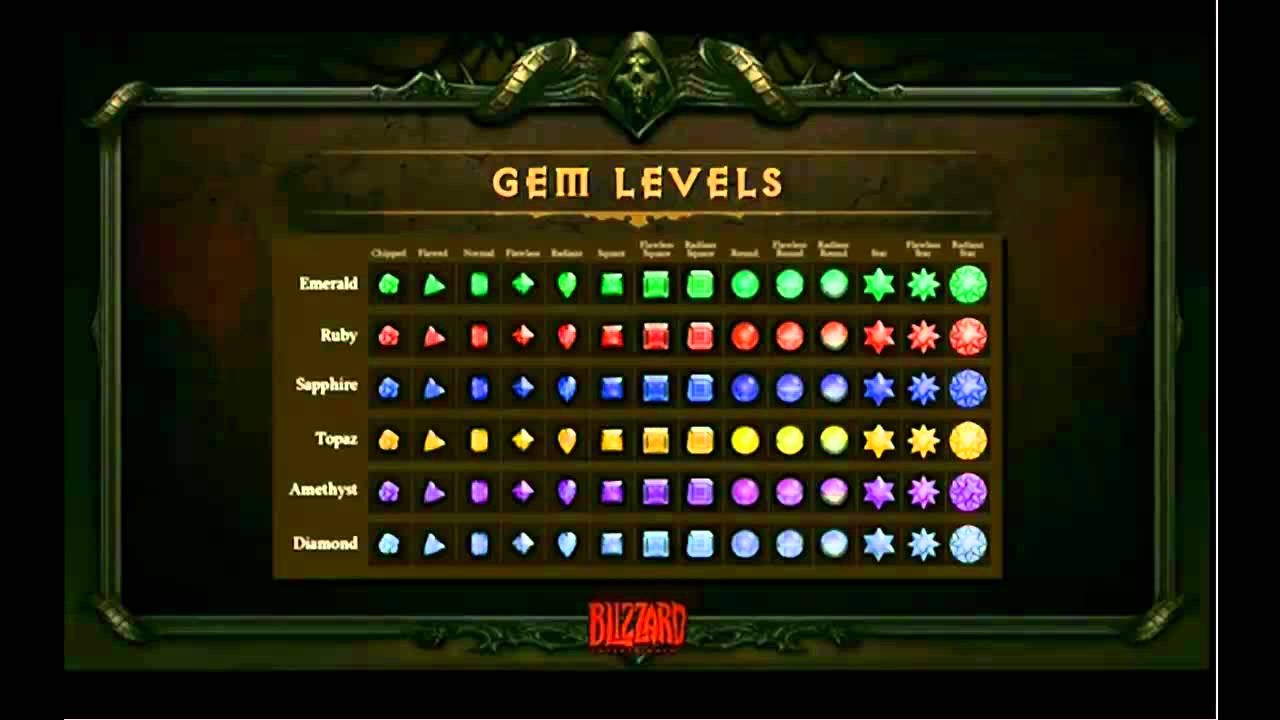
They have fixed stats depending on which type of item you put them into. We largely copied what D2 did, but not exactly since our itemization is different and stating is different. For example, most of our classes don’t have mana, so that wouldn’t work. But things like casting speed and strength and such are there. Gem Levels. The full display of gems in Diablo III. Diamonds & Sapphires have since been removedThe naming convention for gems in Diablo III is similar to how it worked in Diablo II.
The first four levels are the same, with 'radiant' replacing 'perfect' for the fifth level. After the first five there are square, round, and star gems that repeat the top three quality levels. Level 1 - Chipped. Level 2 - Flawed.
Level 3 - Regular. Level 4 - Flawless. Level 5 - Perfect. Level 6 - Radiant. Level 7 - Square. Level 8 - Flawless Square.
Level 9 - Perfect Square. Level 10 - Radiant Square.
Level 11 - Star. Level 12 - Flawless Star. Level 13 - Perfect Star. Level 14 - Radiant StarWith the GamesCom 2011 announcements came a new visual for Gem level progression, which shows different graphics for each individual gem. Gem progression, GamesCom 2011.Upgrading Gems Gems were set to upgrade all along, but initially the developers planned on a 3 1 ratio for all levels. (This was eventually lowered to 2 1 for the first seven tiers, which also had their gold costs cut dramatically in.)Gems are upgraded by the Jeweler, rather than players doing it themselves with a, as in Diablo 2.Gems stack up in Diablo III, making them take up less stash space. Initially they were set to stack to 10 high in a single inventory space.
This was later raised to 30 for launch, and increased again to 100 in a later patch.Initially, gems were only going to be found at level 1-5, which would have made upgrading them all the way to level 14 quite a task. At the 3 1 ratio, that would have required 1,594,323 level 1 gems to make a single level 14 gem (3^(14 - 1)). The length of that becomes absurd when you consider it would have taken 664 hours of nonstop clicking simply to upgrade that many times, at one upgrade per second. Earl version of.The maths isn't quite as daunting going from level 5 gems. In that case it only requires 19,683 level 5 gems to make one level 14 gem.
Happily, Jay Wilson said that they're were open to tweaking the formulae, and in fact the developers did, though in reverse of the Diablo II system of rune upgrading. In that game high level runes became cheaper, and only required 2 to combine to the next level. Diablo III took the opposite approach with gems and lowered the upgrade costs in gold and just 2 1 for the lower 6 levels, while the top 7 still require 3 1.In August 2010 spoke on the design theory behind high level gems taking so long to create. The gem-to-gem upgrade intent is not to have these huge gaps where you feel like you’re lame unless you have level 14 gems in every slot, but as a long term goal for the hardcore min/maxers and PvPers who are going to be playing for a long time and be able to work toward those goals. It’s something you can put a little time into just by upgrading the gems you pick up during normal play, so you’re constantly able to keep working toward the goal of crating a level 14 gem.Also the trading game and millions of people playing for months is going to make them a lot more attainable than they may seem when throwing out numbers like 19,000.It’s possible it may feel crappy or we need to add something to help jump gaps, or, who knows.
It’s all very unproven at the moment, but we think provides a nice long term goal anyone can work toward just by killing monsters and picking up gems.Twinking Gems Gems do not have a Clvl requirement to use, and they are intended to be very useful as twinked items. You can pay an artisan to remove the gems from an item. The last design I had heard of was that it was based on gem value, so as you socket higher level gems it becomes more expensive, but you’ll almost certainly want to unsocket gems to level them up, or swap to new gear. This may cause some unique problems for low level (non-twink) characters attempting to buy high level gems and then being unable to remove them from the socket when they get a better piece of armor (because they can’t afford it), but that may turn out to be an acceptable roadblock.Changing Gem Bonuses.
L3 Emerald bonuses.Until the beta, little was known of the bonuses gems will provide. It was assumed that the higher level gems would grant very high bonuses, to make the huge costs of upgrading worthwhile. This turned out not to be the case, with higher level gems generally just adding another few points to various stats, but players value them anyway as every stat point helps.What particular bonuses gems would provide varied during development, as Jay Wilson detailed during an interview at Gamescom 2010. Can you tell us about gem stats?Jay Wilson: They work much as they did in D2. They have fixed stats depending on which type of item you put them into. We largely copied what D2 did, but not exactly since our itemization is different and stating is different.
For example, most of our classes don’t have mana, so that wouldn’t work. But things like casting speed and strength and such are there.Early Known Gem Bonuses The first sighting of gem stats came from the Artisan Video from Gamescom 2010. That gem was socketed into a shield (shields do not have sockets in the final game) and the hover text showed its potential bonuses:. Weapon: +4% Casting Speed. (This bonus was changed to before release.).
Helms: Attackers take 7 damage. Other: +7 dexterityIn the Diablo 2 expansion, a level 3 emerald grants:. Weapons: 17 poison damage over 1 second. Armor & Helms: +6 dexterity. Shields: +22% Poison Resistance. Clvl 12 required for allThe numerical bonuses (but not the type of bonus) from gems changed from D2C to D2X, but clearly there are major differences in more than the numbers. Diablo 3 grants entirely different types of bonuses, and categorizes the socketable items differently as well; helms/armor no longer share the same bonuses.These changes are largely due to the game's different combat mechanics and character requirements, but were also somewhat required by the different itemization issues.
For instance, in helms/armor grant +mana in Diablo 2, but +mana isn't a viable bonus in Diablo 3, since only the has mana for a resource. Even considering that, the changes to the Emerald are quite large. In Diablo 2, most gems provided resistance in shields and elemental damage in weapons. Emeralds in D3 do neither of those things.More Gem Stats More gem stats were seen in photos from the Blizzcon 2010 demo. At that point the current version of the game had a whole new (and short-lived) system of, so the stats were out of date, and then later came back in-date. Gem stats from Blizzcon 2010.Chipped (level 1) granted:. Weapon: Spells deal 10% more damage.
Helm: +2% Chance to Block. Other: +2 StrengthFlawed (level 2) granted:. Weapon: +0,03 Attacks Per Second. Helms: +3% Movement Speed. Other: +2 to all AttributesAs you can see, a Chipped (level 1) grants +2, while a level 3 (as seen in the Youtube video ) grants +7.It is possible that it is always the bonus granted from the gem a level below it + the level of the current gem that decides how much bonus a given gem gives to an attribute.
In Path of Exile, many items contain colored gem sockets. Skill gems of the matching color may be placed into these sockets to immediately gain access to that skill. Gems can be removed from sockets at any time with no penalty. The size and type of item will influence how many sockets it can hold. Most armor pieces can have up to four sockets. High end body armor can reach six sockets. One-hand weapons and shields cap out at three sockets, while two-hand weapons can contain six.
In addition, the attribute alignment of the item will influence which colors the sockets will be. For example, a Strength/Dexterity sword is very likely to contain red or green sockets and unlikely to have blue sockets.Linked SocketsA sword with four linked gem sockets.Sockets can also be linked to adjacent sockets forming groups of linked sockets. A support gem may be placed in a socket linked to a skill gem and the support gem will modify the effect of the skill gem. For example, an item may be found with two sockets linked to each other. A player can place the skill gem into one socket and the support gem into the other which will allow the player to fire multiple fireballs at once. Placing two skill gems into linked sockets will have no effect beyond giving the player access to both skills. An item can have multiple socket groups.In the event of three or more linked sockets, as in the item pictured, all of the support gems in the socket group will modify the effects of all skill gems in the socket group.
For example, the player may place two skill gems and two support gems into the four linked sockets and both support gems would augment the effects of both skill gems.The effects of similar skill and support gems do not stack. If two or more of the same gem are equipped, the one with the higher level is used for calculating the effect. However, if two of the same skill gems are placed into two separate socket groups, the skill will benefit from the effects of all support gems linked to both skill gems.